
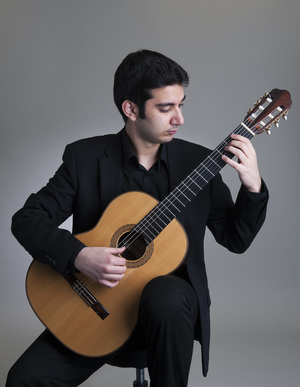
Strathearn Music Society Review – Sasha Savaloni
Wed 19th October 2022
Autumn concert-going routines are now firmly re-established and it felt good to be part of a pretty full house in St Andrew’s Halls last Wednesday for an evening of guitar music with Sasha Savaloni. Crieff is hugely fortunate to have such a perfect venue for chamber music; it provides a warm and responsive acoustic alongside the required intimacy and scale which are seldom found in larger concert halls. For the guitar it could hardly be better, and the concentration and focus of the audience on this occasion was palpable.
There’s not much that today’s generation of guitarists won’t turn their hand to, and this programme consisted mostly of Schubert (transcriptions of songs from Schwanengesang) bookended by two contemporary pieces with a Shakespearean theme.
Much has been written and conjectured about Schubert and the guitar and Savaloni himself is currently engaged in research into the subject, so it was intriguing – and utterly captivating – to hear his selection of a dozen familiar lieder interpreted (re-imagined?) by a single instrumentalist. First things first: the guitar can sing, make no mistake about it, and the composer’s original vocal lines as well as all the inherent lyricism and subtle variety of the piano parts were all captured faithfully and sensitively. Furthermore, making a virtue out of necessity, Savaloni created a newly-paced and infinitely flexible framework for each song, where rubato felt totally natural and every bit as convincing as the more metrical rhythms of the familiar voice and piano versions. It was a particular pleasure, and seemed so apt, to hear the lovely Ständchen (Serenade) played so thoughtfully and affectionately on the instrument which we imagine being strummed by romantic suitors beneath the windows of their lady-loves, but even those songs (Der Atlas, Der Doppelgänger, etc) in which the power and sonority of the piano would seem to be an essential ingredient communicated their drama and poetry just as effectively through the pared-down medium of six relatively quiet strings.
Received wisdom has it that Schubert revolutionised song-writing by investing his music for both singer and pianist with equal and complementary measures of depth and interest, and that has never been in doubt. What is equally unarguable, however, and came over so clearly in this performance, is that the purely musical content of his whole conception is more than strong enough to convey its message and feeling in whatever medium it is conveyed. To put it simply, he wrote immortal and wonderful tunes, along with all that that entails.
Framing this wealth of Viennese melody, and in perfect contrast, were Stuart Macrae’s “Tomorrow and tomorrow and tomorrow” and Philip Houghton’s “Ophelia”. The former, an excerpt from Macrae’s “Macbeth” sonata for guitar, was commissioned by Savaloni himself and received its première only last year; it is, not surprisingly, a dark and brooding piece referencing the passing and extinguishing of time with its quirky rhythmic tics and, ultimately, the fatalistic acceptance of mortality. “Ophelia” (subtitled “a haunted sonata”) is hardly less mournful in mood but nevertheless manages to convey soothing tones of comfort and beauty as its falling intervals depict Ophelia’s descent into the watery depths.
A cheering postscript was assuredly necessary after such doom and gloom, and was happily forthcoming, in the shape of the delightful Estrellita by the Mexican composer Manuel Ponce, rounding off this wholly enjoyable and satisfying concert with a smile and at least the possibility of sunshine.
